The New QB Acquisition Paradigm: Blue-Collar Basics

Quarterbacks are everything. It’s not a bad strategy to take proven players over high school question marks. You don’t need to train him up, you don’t need to deal with duds, you don’t need to convince them to sit for a year, and you don’t have to worry about poaching. The strategy just makes way too much sense in today’s college football landscape.

How long it lasts is another question. Maybe in a few years contracts get tighter. But for now it seems the optimum strategy.

Quarterbacks are everything. Just think about the good offenses and defenses Miami’s had over the last 20 years. Think about the various top ten rankings and possible runs we could have made. The key ingredient that was always sorely lacking was QB.

Two years ago, heck even last year after Cam Ward, only the most blatant Miami homers would have thought we had a chance to make the national championship game, or even have a good playoff run for that matter. But here we are.

And it’s because we developed stout lines and a good team, absolutely, but none of that would have gone anywhere without buying Beck and Ward.

So Mario would be stupid to get away from what works. It ain’t broke, don’t fix it. Snag a proven QB to lead a well built and trained team. It’s a match made in heaven for the coaches, the team, AND the QB, since he sees exactly who will be protecting him and who he’s passing to. Win, win, win.
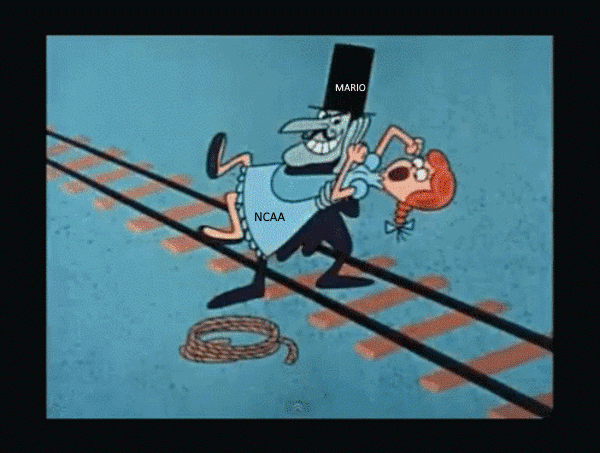
At some point though if this is our strategy then why would a HS kid even come here?

1 Like

Thinking about this some more, my point isn’t as obvious as saying QBs are important, it’s to comment on the new QB acquisition paradigm apparently developing.

I think of it as Blue-Collar Basics.

What you do is simple: build a team of support staff attractive to top-level QBs. The idea isn’t new, but it’s shockingly effective in this early age of the transfer portal.

Think about it. If you’re a QB, what’s the most important thing you want on your team? Number One I’d say is O Line. Protection. You want a stable of experienced guys who push the line, open holes, and give you the time and space to make plays.

Number Two is also obvious: great receivers. You want targets who’ll make you look good.

In both these cases, you don’t just want one huge flashy star. What you really want is a cohesive team, consistency, and depth. The line can rotate and you’re still safe. Multiple receivers are more targets and more options. Injuries are mitigated.

This is why this starts with blue-collar players first. You need those years of team-building, studying the system, and practice. And that steadiness is what Mario’s been building.

When it’s time to take a QB, you don’t need to play the multi-year recruiting games, gamble with a high school kid, or focus on development time. Instead you find a top QB of the moment and tell him, “This is the team you can play with next year.”

Let’s develop the blue-collar boys a little more. Number Three in a QB’s list might be running back. They give QBs an out and take pressure off. Again, a single star might not be as attractive as a stable of 2 or 3 solid guys.

And, I dunno, Four might be a strong defense in general so you’re not always playing under the gun.

(Notice I haven’t mentioned QB coach. Besides young kids not always being mature enough to realize they need to sit and study, they might not value this aspect as much. But, again, a huge strength of this new paradigm is that you don’t bother to develop the QB. He’s a done deal for probably a one-and-done year. Let him play his game.)

Granted, the second part of this strategy is paying a QB loads of money, so maybe we’ll call it Blue Collar Basics and a Bag. But it’s hard to deny this paradigm has a lot of strengths all feeding into each other right now.

And when you think of building an effective team of blue-collar players, and then igniting that TNT with a star quarterback, is it any surprise that our opponent in the college football championship is Indiana?

Both teams rose to sudden national prominence in 2 years using Blue Collar Basics and a Bag. This paradigm’s not going away. It’s just starting. And we should enjoy the ride while it lasts.

I have to say that the alleged tampering from UM to Mensah does not look good for us after the Lucas “tampering” at Wisconsin. I believe tampering, on some level, happens all the time but the it’s magnified when it’s us. Let’s hope this isn’t the case with Mensah.

Miami is not the only one tampering.

1 Like

Agreed but we are always the ones under scrutiny

You are miami. Lol.

1 Like

College is turning into semi pro anyways. Its possible teams decide they don’t want high school QBs at all.

Of course there will always be filler / backup guys that come for the reps and garbage time, as always.

Sports Illustrated article with some points i mentioned.

Its not just us and Indiana:

Indiana leaped from good to great this season with the arrival of Fernando Mendoza, who won the Heisman Trophy and now figures to be the first QB taken in the draft. Miami snatching Beck (at great cost) solidified a team that already had massive talent along both lines of scrimmage. Despite coming from well off the radar in Division II, Trinidad Chambliss helped elevate Mississippi to playoff semifinal status.

It perpetuates a pattern—Ohio State won it all last year with first-year transfer QB Will Howard, and Notre Dame made the title game with first-year transfer Riley Leonard. Building a great team still requires many parts, but quarterback is the place to start and the place to spend an increasingly large amount.

And it’s not just a single-year strategy:

(Perhaps not coincidentally, the Buckeyes and Irish fell short of expectations and aspirations this season with young QBs who were in their first season as starters. Both Julian Sayin at Ohio State and CJ Carr at Notre Dame had excellent years, but Sayin finished poorly and Carr started slowly. Getting old and staying old at that position looks smarter every season.)

Likewise, the bag is just the start. You need to sell QBs on the team:

“I had to sell Cam before the success, which is sometimes harder. I had to sell him on the picture of like, ‘Look, man, I’m going to put you in a position where these NFL teams are going to view you as the top quarterback because you’re going to play in a system where you’re going to have to make checks, a lot of the things that you see in the NFL. And you’re going to play behind an O-line that can really block.’ And then flipping the page to next year and getting Carson, it was important to show that this offense is not just for one type [of] quarterback.”

Its just undeniable. For some teams this is the new way of doing business.

I don’t believe you need an older quarterback to win. It just happens that the guys who have played the past couple of years were older. What about Jameis, Lawrence, Watson. They were alll freshman who won the NC. These things have ebbs and flows. Things change quickly. Eventually Miami and these other schools will miss on an older QB or they get hurt and you are stuck playing one of your younger QB’s. One of them will pan out and win it all.

1 Like

The portal model is definitely safer one at this time as long as you get one of the handful (or less) QBs you are after. Especially when you bring spending money into the equation.

You worry about

The whole nation is tampering and accusing everyone of tampering.

Maybe Mensah’s agent reached out to UM when it was made public the type of money we were talking about? I mean either way that’s going to be everyone involved’s story.

The agents are reaching out. The way it works is during the season the agents are speaking with different schools. They have this pff platform these colleges pay for and watch the film. They will tell the agent they are interested and thats how this crap gets done.

1 Like

Let the church say “Amen!”